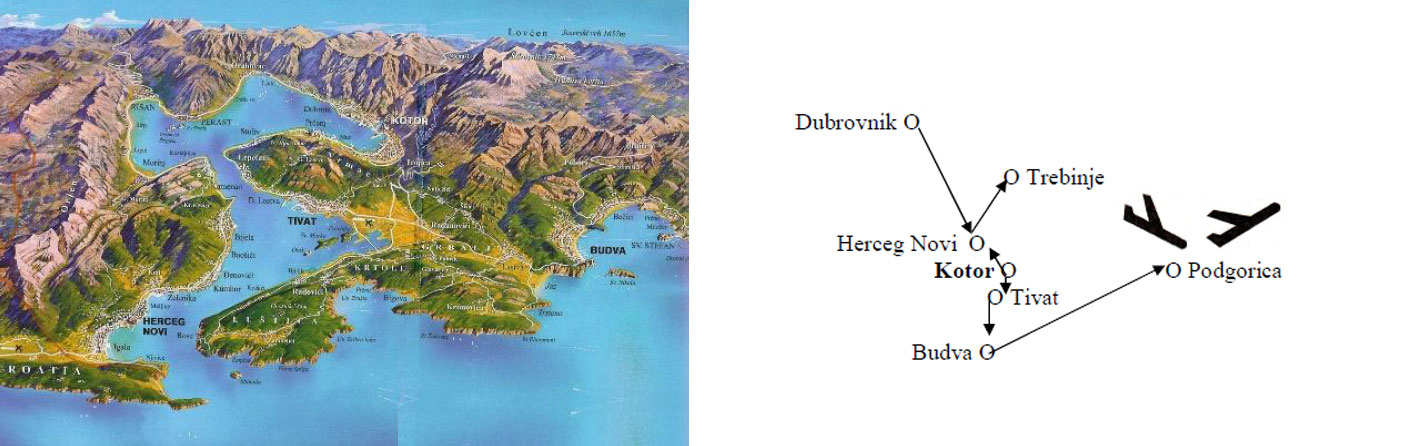
In September 2022, the study tour led to the fascinating fortress heritage around the Bay of Kotor, with fortification structures of the Venetians, the Ottomans, the Habsburg Monarchy, the Second World War, and the Cold War. In addition, the fortresses in Trebinje, Herceg Novi, Dubrovnik, Tivat, and Budva were visited.
(Photos: H.-R. Neumann)

Expansion of contacts in Dubrovnik
During their study tour to Montenegro, on 29 August the German-speaking participants were able to take part in a joint meeting at Dubrovnik City Hall with Deputy Mayor Jelka Tepšić, Cultural Affairs Officer Dr Julijana Antić Brautović, and the Director of the Dubrovnik Restoration Institute, Mihaela Skurić. In the presence of the new President of the Society of Friends of Dubrovnik Antiquities and member of FORTE CULTURA, Vedran Kosović, Ms Tepšić confirmed the continuation of the Society’s membership. Together, topics for further cooperation were discussed, which are to be examined in greater depth during the members’ conference in 2023.
Following the meeting, another gathering took place in the representative rooms of the Society at Gundulićeva poljana 6 with its Managing Director Maro Kapović and the Technical Secretary Lukša Hanza, BBA, as well as a joint visit to the exhibition “70 Years of the Society of Friends of Dubrovnik Antiquities”, which had been extended by one day especially for this occasion.
Turkish–Venetian fortress construction in Herceg Novi

In the presence of the local head of tourism, Biljana Belusević, and the local fortress guide Alen Filipović, the fortress complexes Forte Mare, Fort Kanli Kula, and Fort Spanjola in Herceg Novi were also visited during the Montenegro study tour. While the latter is still awaiting rediscovery, the other two forts are used primarily for event tourism. In a television interview with the local broadcaster Radio Televizija Herceg Novi, Biljana Belusević emphasized the necessity of a partnership and membership in FORTE CULTURA.
The visit of an international group of specialists and researchers showed that interest in these historical structures extends far beyond the city and the country. This interest should be further developed and at the same time serves as proof of how important supra-regional marketing is. This visit must also be discussed more intensively in the city council, with a view toward Europe and the associated funding opportunities.
Video report – local TV
Cross-border talking
Back in the days of the Yugoslav Navy, Fort Punta d’Ostro on the Croatian peninsula of Prevlaka served as a target object. The bullet impacts are still visible today. During their Montenegro study tour, the participants were allowed to carry out a site inspection under the leadership of Dr Neumann. Knowledgeable guides were the representatives of the owner, Ivo Radonić from the Konavle municipal administration, and the Society of Friends of Dubrovnik Antiquities responsible for the restoration, represented by its Technical Secretary Lukša Hanza.
The fort is located in a commanding position at the entrance to the Bay of Kotor, only a few minutes by boat and within sight of the Montenegrin fortress island of Mamula. On the uppermost of a total of five gun levels, a highly interesting discussion developed with the Montenegrin professor of architecture and fortress specialist Dr Ilija Lalošević regarding the tourist interaction between Punta d’Ostro and Mamula, should the fort one day indeed be developed into a future naval museum.
For all those present, there was no doubt that both sites could play an exceptional and significant role within a cultural route such as FORTE CULTURA.
Budva: a new partner in FORTE CULTURA?
On the last day of their study stay in Montenegro, on 3 September, all participants were granted the opportunity to visit the fortified heritage of the Adriatic city of Budva. This includes the northern Fort Mogren, which has recently been restored, the Fort Kosmač dating from the Austro-Hungarian period, as well as the defensive walls of Budva’s old town. Public attention to the visit was shown not only by Iva Pavlović from the municipal EU Office for Integration and Cooperation, but also by the camera team of the local TV broadcaster “Radio Televizija Budva”. At the prominently located Fort Kosmač, the team took the opportunity to record the positive travel impressions of the tour participants. At the same time, it also conducted an interview with the young graduate architect Ivan Vratnica, who is currently working on a revitalization of this fort and sees good prospects for developing it, as the southernmost fortress monument of Montenegro, into a highlight of the region. The interest in a membership in FORTE CULTURA is to be presented to the city’s mayor.
 English (UK)
  Deutsch
  Français
  Italiano
  Polski
  Español
Leave a Reply