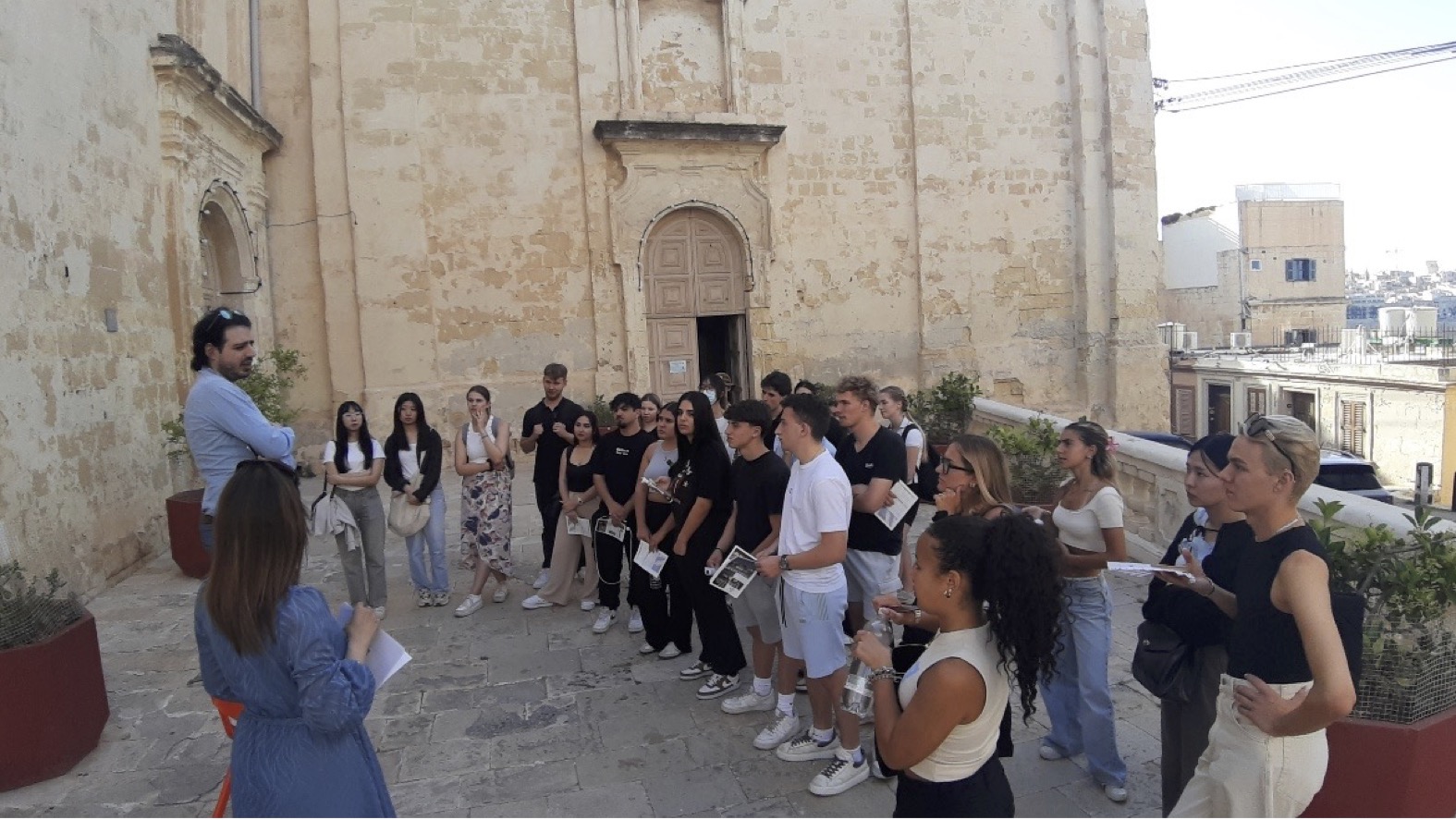
A site visit with a difference. Tourism students from the University of Malta receiving game instructions at the start of a Scavenger Hunt at the historic town of Senglea, Malta.
Contribution by John Ebejer, Associate Professor of Tourism at the University of Malta and member of the FORTE CULTURA Scientific Committee.
This article offers suggestions on how to collaborate with universities. These suggestions are intended for managers and curators of fortified heritage sites, including castles, fortified towns, lines of fortifications, fortified landscapes and any other physical element created for purposes of defence. They are also of interest to museum curators and managers of visitor attractions with a fortified heritage theme.
First of all, some information about my background. I have ample experience of both professional work and academia. I worked extensively as an urban planner and project coordinator. In particular I led a team of professionals on a major fortified heritage project in Valletta. I am now an Associate Professor at the University of Malta where I have been teaching for the past fifteen years.
Why reach out to universities?
Collaborations with universities enable managers to raise awareness about their fortified heritage site. In particular it makes more people aware of the site’s cultural and historical value.
How do you find university academics who may be interested in your fortified heritage site?
To collaborate with a university, you will need to identify a university academic who potentially would be interested in your site.
The first step is to draw up a list of universities that are, say, within two hours drive from your site. Apart from one or two well-known universities, many cities have other less known universities and higher education institutions.
For each university, look at its website and identify teachers with an interest in tourism management, heritage, architecture or urban planning. Use the search function. You can also search for university departments that include tourism, culture or architecture in their title. Academics with an interest in fortified heritage are more likely to be located in such departments.
University websites normally include a short cv for each academic. By checking the cv you can establish the likelihood that an academic would be interested in your site.
Searching for a suitable university academic is time consuming so you will need to persevere. However finding the right contact could derive many benefits.
How can fortified heritage sites and universities collaborate with each other?
Once you have identified an appropriate university teacher, there are several different ways how to collaborate. It is suggested that you invite the teacher to organise a group of their students to visit your site. Site visits (or field trips) promote student learning in a manner that is interesting and enjoyable. Some academics are eager to organise field trips because of their usefulness for their student learning.
A site visit can be given a gaming twist to make it more fun for students. This could take the form of a quiz or a scavenger hunt. Of course the downside to this is that it takes a lot of time and effort to organise.
For visits to interesting sites, university teachers like to give an assignment for students to carry out. This could involve observation, interviewing or some other form of research activity.
Raised awareness of your site could lead to research initiatives by the university academic or by one of their Masters students. Academic research about your site will lead to new knowledge that could be of cultural or even commercial interest to you.
The subject of the research could be about the fortified landscape, the architecture, the commercial potential or about visitor management. This depends on the background and interests of the researcher. By networking with universities, you are more likely to be approached by academic or a student for the purpose of research about your site.
A third potential collaboration is EU-funded projects. European Union institutions regularly issue calls for project proposals in relation to tourism, culture and/or heritage. Many university academics are motivated to submit applications in the hope of securing project funding. Academic project proposals often require non-academic partners including public entities and private companies. These projects are normally research-oriented and often involve aspects relating to information technology and sustainability. Establishing contacts with universities enables fortified heritage sites to make themselves available as partners for such projects.
If you would like assistance to find university collaborators in your region, write to office@forte-cultura.eu or to john.ebejer@um.edu.mt .
 English (UK)
  Deutsch
  Français
  Italiano
  Polski
  Español
Leave a Reply