
Autor: Tomáš Jirouch
Zdjęcia autorstwa: Tomáš Jirouch, Tomáš Karlík; https://brutalassault.cz/sk/o-brutalu
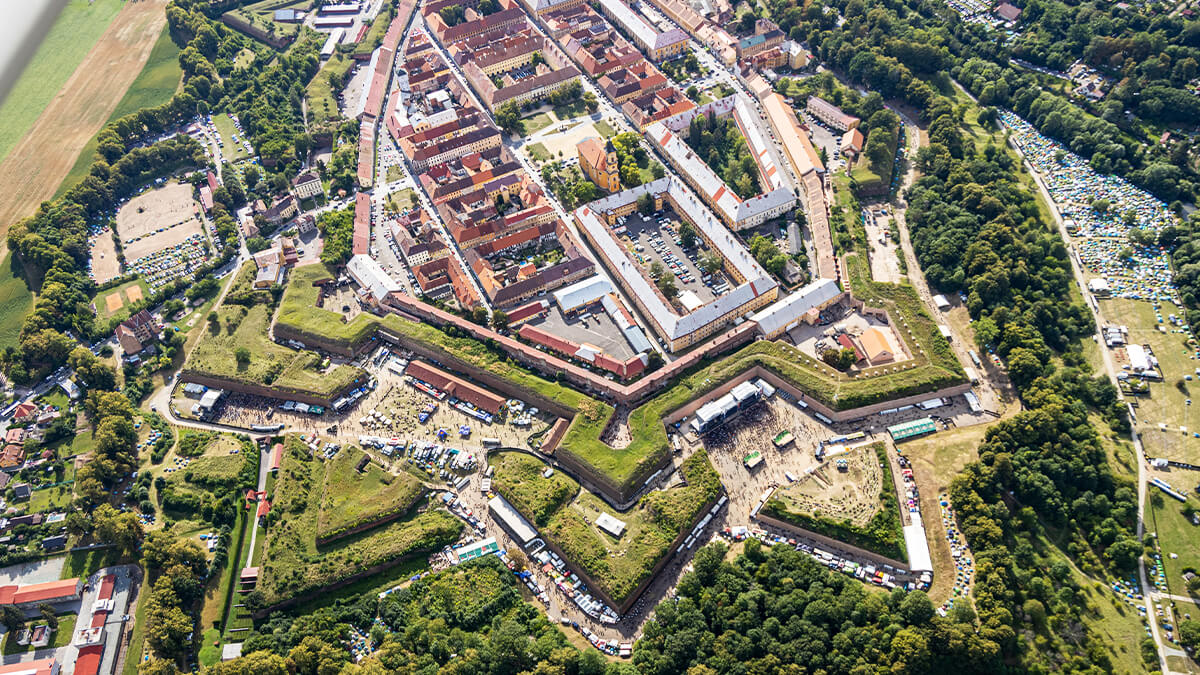
Every August, Josefov in the Czech Republic transforms into one of Europe’s most remarkable cultural destinations. Tens of thousands of visitors from across Europe and around the world gather inside the eighteenth-century military fortress to attend Brutal Assault, one of the world’s leading festivals dedicated to extreme music.
Brutal Assault is far more than a music festival. It has become an outstanding example of how historic fortifications can successfully host contemporary cultural events while preserving their unique architectural character. Rather than serving merely as a spectacular backdrop, Josefov Fortress becomes an active participant in the visitor experience, where history and modern culture reinforce one another.
The festival is also included in the Lato w europejskiej twierdzy, coordinated by FORTE CULTURA that promotes cultural events taking place in historic fortresses across Europe. Brutal Assault represents one of the largest and most internationally recognised events, attracting visitors who might otherwise never discover Europe’s exceptional fortified heritage.
Presentation “History of Josefov”
Tomáš Jirouch, representing Bastion I and the Underground in Josefov (member of FORTE CULTURA), gave a presentation on the History of Josefov. As the presentation was delivered in English, it was also an excellent opportunity to introduce the audience to other fortresses across Europe. After all, a significant proportion of the presentation visitors (about 80 participants) were international, with guests from Germany (also from Berlin) and Poland, as well as from Denmark, the Benelux countries or Italy. Czech visitors represented only a small minority of the wide audience.
In the context of Josefov, it was particularly relevant to highlight other examples of fortified ideal cities and their shared European heritage. The presentation therefore also shortly introduced fortresses such as Fredericia (DK) or Daugavpils (LV). Special attention was of course given to Terezín (CZ) or Klodzko (PL). By placing Josefov within this broader European context, the presentation showed how individual fortresses can be understood not as isolated monuments, but as part of a wider network of fortified heritage sites that share common architectural, historical and cultural traditions. The audience was encouraged to discover and visit fortresses in their own countries.


A Fortress Unlike Any Other
Josefov remains one of the best-preserved bastion fortresses in Central Europe. Massive ramparts, brick barracks, underground tunnels and spacious courtyards create an atmosphere that no purpose-built festival venue could ever replicate.
The organisers have embraced the site’s unique character. Instead of replacing the historic environment, the festival integrates its stages, galleries, cinemas, exhibitions and relaxation areas into the existing military architecture. Visitors experience concerts while simultaneously discovering the fortress.


Cultural Heritage Driving Regional Development
Brutal Assault demonstrates how cultural heritage can become a catalyst for regional development. Every year, thousands of international guests generate significant economic benefits for local accommodation providers, restaurants, retailers and tourism services throughout the region. Equally important is the visibility the festival provides for Josefov Fortress itself.
Another remarkable example of the connection between Brutal Assault and the preservation of Josefov is the BA SOBĚ initiative. Since its establishment, this volunteer programme has brought together festival supporters who dedicate their time and energy to helping with the restoration and maintenance of the fortress throughout the whole year. Volunteers have participated in activities at locations such as Ravelin No. XIV, where they helped with the renovation of historic facilities including the restoration of a wooden floor in the former barn.
Through BA SOBĚ, visitors are no longer only spectators of a cultural event – they become active participants in the preservation of the place that hosts it. The initiative represents a powerful example of community-driven heritage care, demonstrating how a modern cultural event can create a lasting relationship between people and historic architecture.


Brutalists repairing the fortress in 2016
The balance between preservation and contemporary use has become an increasingly important topic throughout Europe. Josefov demonstrates that large-scale cultural events can successfully coexist with heritage conservation when managed responsibly.
 English (UK)
  Deutsch
  Français
  Italiano
  Polski
  Español
Dodaj komentarz